

Clean kitchens. Clear conscience. Real savings. Staff health, air quality and environmental discharge: the trade-offs of harsh chemical cleaning that GreaseOff simply removes.
Most commercial kitchens have a bottle in the store that nobody wants to be the one using. It is usually the caustic degreaser reserved for the worst jobs: the one with the gloves-and-ventilation warning on the label, the one that strips grease fast because it is aggressive enough to strip other things too. A genuinely non-toxic kitchen cleaner is supposed to be the alternative to that bottle, not a weaker version of it.
This piece looks at what harsh chemical cleaning costs beyond the invoice (staff exposure, air quality, and what ends up in the wastewater) and at how GreaseOff’s non-toxic, phosphate-free, not-enzyme-based formulation is built to close that trade-off rather than manage around it.
The chemical store
The chemicals most kitchens don’t think about
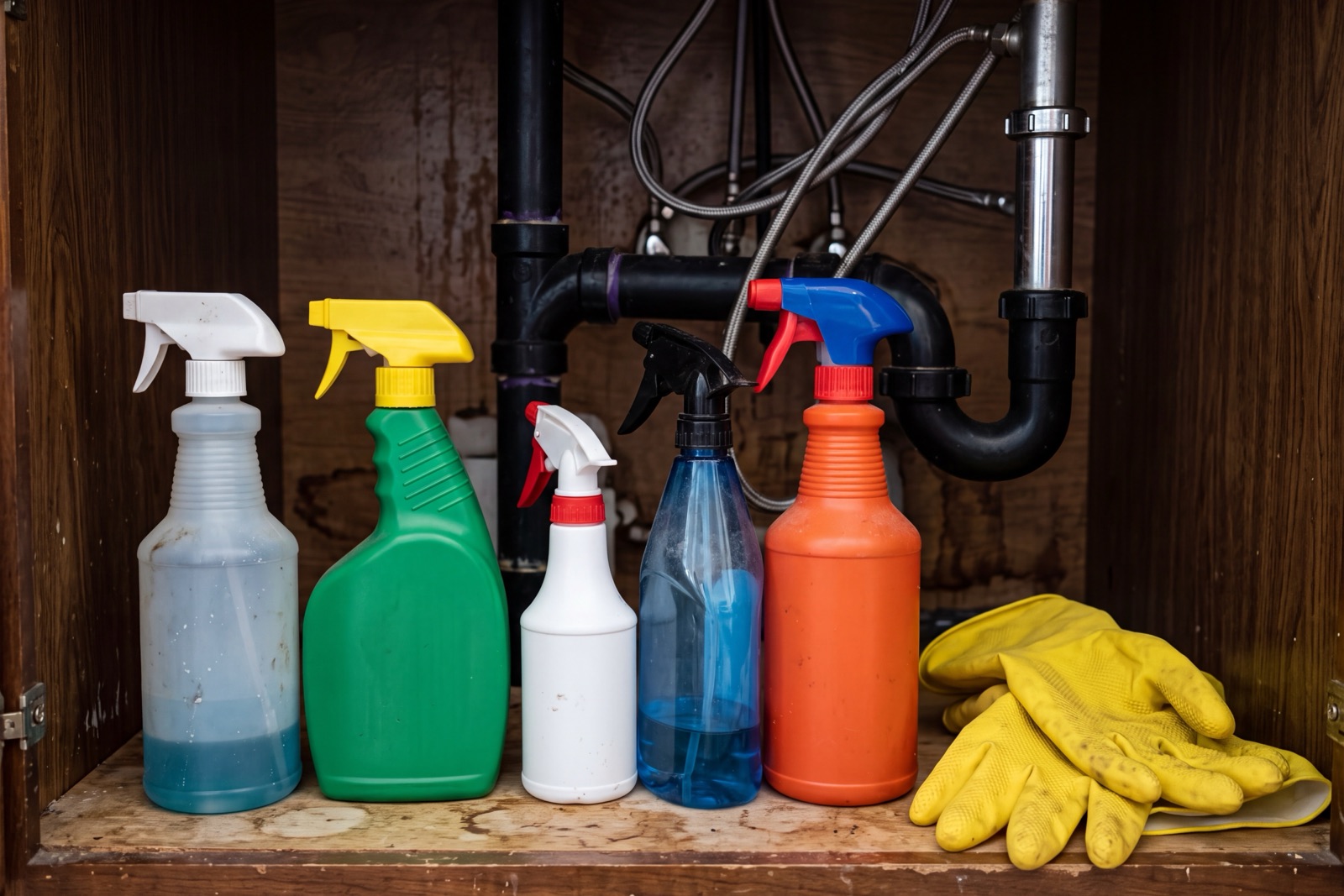
Caustic degreasers, chlorine-based sanitisers and enzyme drain treatments are so routine in a commercial kitchen that they stop registering as a decision. They get reordered because they were ordered last time. Few kitchens run a formal review of what is actually in the chemical store, what each product is rated for, or what happens to it after it goes down the drain.
That is not a criticism of kitchen managers; it is a reasonable response to a category that has never made the comparison easy. Chemical-free commercial kitchen cleaning, which in practice means cleaning without the harsh chemicals, is usually framed as a compromise: safer, but slower, or more expensive, or less effective on the hard jobs. GreaseOff’s formulation is the direct test of that assumption.
The hidden costs
What harsh degreasers do to staff, drains and the environment

Harsh caustic and chemical degreasers carry real costs that rarely make it onto a chemical cost comparison. For staff, that means skin and respiratory exposure risk, mandatory protective equipment, and the training overhead of making sure every new starter handles a hazardous product correctly in their first week. For the kitchen’s air quality, it means fumes that build up in enclosed prep and wash-up areas without strong extraction.
Downstream, it means what actually reaches the drain and the fat trap. Phosphate-heavy formulations contribute to wastewater load in a way that is a compliance and environmental concern for larger operators, not just a sustainability talking point: Cape Town’s effluent by-law, for one, caps total phosphates discharged to its sewers at 25 mg per litre.
The formulation
Non-toxic, not enzyme-based: how GreaseOff is formulated differently
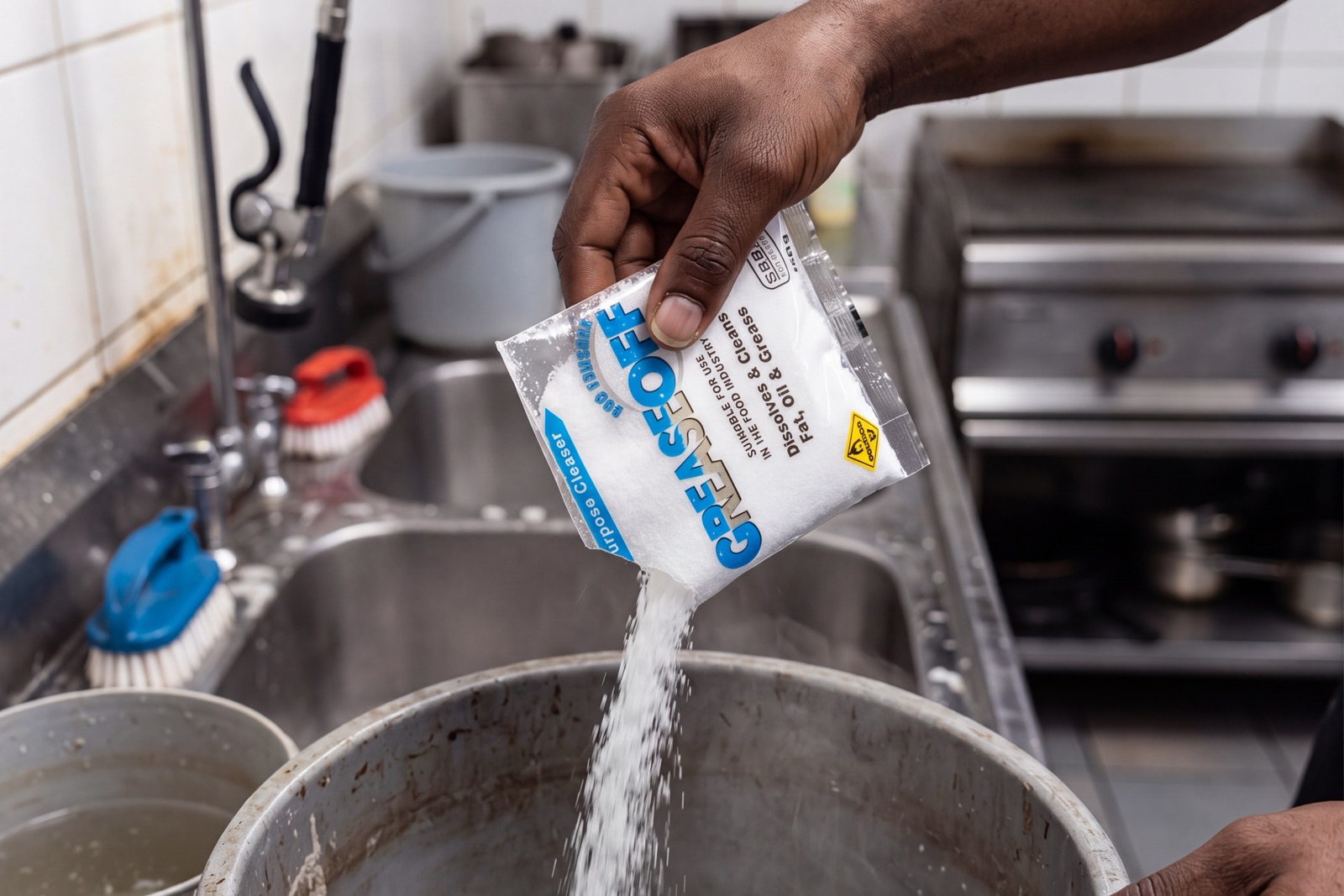
GreaseOff is non-toxic, phosphate-free and 100% biodegradable, and it is SABS 1828 certified for use in the food industry. The formulation that is safe on a prep surface is the same one used on the canopy and the trap, not a diluted version reserved for “gentle” jobs.
It is also, deliberately, not enzyme-based. That distinction matters operationally as much as it does on a safety data sheet: enzyme cleaners work by biological action, which makes them slower to activate and sensitive to temperature, and gives them a shorter usable shelf life once mixed. GreaseOff’s bio-science formulation is built to avoid that trade-off: a product GreaseOff sells as non-hazardous to use, that does not lose the operational speed a busy kitchen needs.
The audit
A responsible operator’s checklist for chemical safety
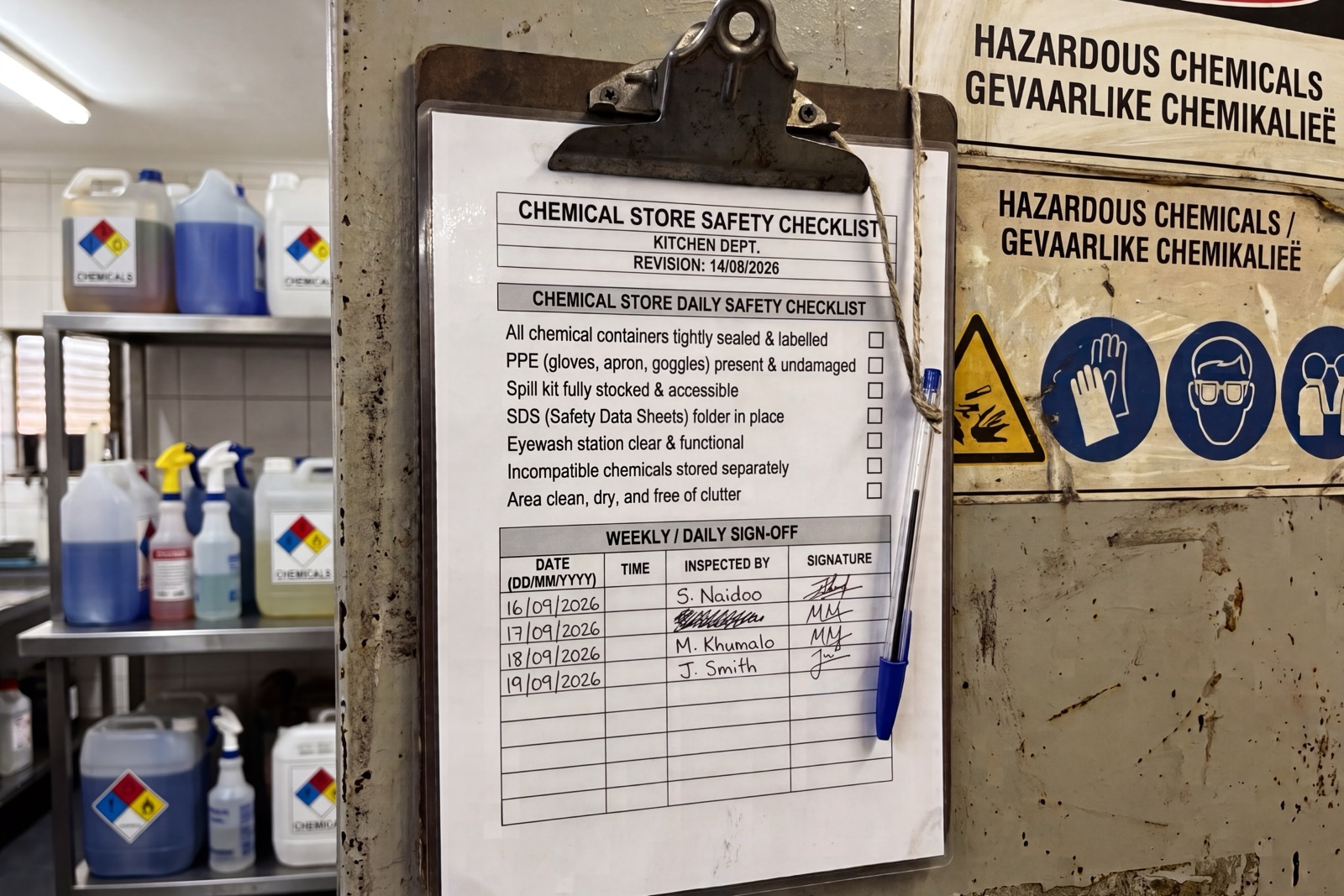
None of this is an argument against every harsh chemical in every kitchen; some jobs genuinely need aggressive chemistry. It is an argument for auditing which jobs actually do, rather than defaulting to the strongest bottle out of habit. A kitchen worth calling responsible on chemical safety can answer, product by product: is this necessary for the job it does, is it the least hazardous option that does that job, and does the person using it understand why.
GreaseOff is offered here as the worked example of what removing that trade-off looks like in practice, not as a claim that every harsh chemical in a kitchen store is unnecessary.
The trade-off GreaseOff removes
Conventional degreasers
- Grease High performance on grease
- Handling Hazardous handling, PPE (personal protective equipment) required
- Drain Phosphates often discharged to drain
Enzyme-based cleaners
- Profile Eco-friendly profile
- Activation Slow, temperature-sensitive activation
- Shelf life Short usable shelf life once mixed
GreaseOff
- Handling Non-toxic, as described by GreaseOff
- Drain 0% phosphates, 100% biodegradable
- Base Not enzyme-based: fast-acting, stable shelf life
Product information and trade enquiries at greaseoff.co.za · Non-toxic · phosphate-free · SABS 1828
For the kitchen and the buyer
Frequently asked questions about non-toxic commercial kitchen cleaning
Is a non-toxic cleaner as effective as a caustic degreaser?
GreaseOff is formulated to be aggressive enough for grease trap and canopy cleaning while remaining non-toxic and safe on food-contact surfaces; the same solution is used across both jobs rather than one product for each.
What does phosphate-free actually change?
Phosphates in conventional cleaning chemicals contribute to wastewater and environmental load once discharged. A phosphate-free, biodegradable formulation reduces that downstream impact without changing how the product is used in the kitchen.
Why does it matter that GreaseOff is not enzyme-based?
Enzyme cleaners rely on biological activity, which is slower to work and sensitive to temperature, with a shorter shelf life once mixed. A bio-science, non-enzyme formulation avoids those constraints while keeping the non-toxic, biodegradable profile.
Do staff still need protective equipment to use it?
GreaseOff describes its product as non-toxic and not hazardous to use. The protective equipment for any cleaning chemical, GreaseOff included, is set by its safety data sheet: ask the supplier for it, keep it on file, and follow it. Standard kitchen hygiene practice still applies.
Sponsored content · This feature was produced by Hospitality Marketplace in association with GreaseOff. Formulation details supplied by the brand.



Leave a comment