

Smart Kitchens and Thicker Margins are becoming essential for hospitality operators trying to survive relentless food inflation and operational inefficiencies. In modern kitchens, technology is no longer optional. Data-driven systems, AI-powered waste tracking, and automated draught monitoring are transforming how chefs and operators protect their bottom line.
Adopting a Smart Kitchens and Thicker Margins strategy means replacing manual guesswork with connected equipment, real-time analytics, and predictive inventory systems that drive profitability.
Operators exploring emerging hospitality technology trends can also read the Hospitality Marketplace hospitality technology insights to understand how innovation is shaping restaurant and hotel operations.
The Brutal Reality of the Bin
The brutal reality of 2026 is that relentless food inflation is actively destroying profit margins across South Africa. Let us look at a real scenario in a busy Johannesburg grill house. If your food cost sits at 35 percent and your waste margin creeps up by just three percent, you are bleeding hundreds of thousands of rands directly from your net profit over a year.
The cost of backdoor shrinkage and plate waste is simply too high to rely on gut feeling and manual spreadsheets. Executive chefs must deploy an ecosystem where physical kitchen equipment speaks directly to smart software to lock down the bottom line.
Global Verified Cases
Teaching a seasoned South African executive chef about basic portion control is an insult to their experience. What operators actually need is to see how the top one percent of global kitchens are deploying artificial intelligence to bulletproof their margins. Smart scales are no longer just digital weighing pads sitting in the receiving bay. The global standard is computer vision waste tracking.
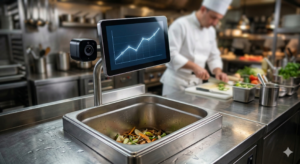
High volume kitchens are mounting AI enabled cameras directly above their primary scrape bins. Systems like Winnow Vision use advanced image recognition to identify exactly what is being thrown away in real time. The camera physically scans the item, categorises it, and instantly calculates the exact rand value of that specific waste.
This is not theoretical tech. Hilton recently deployed Winnow across 13 hotels in the Middle East, resulting in a staggering 62 percent reduction in food waste. Similarly, IKEA rolled this AI out across their United Kingdom stores, cutting food waste by 50 percent and saving over 1.4 million pounds in a single year.
Algorithmic Inventory and Menu Engineering
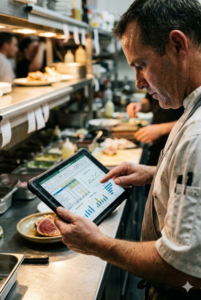
This connected hardware feeds massive amounts of data into your back of house software, shifting menu creation from an emotional process to a purely mathematical one. Predictive yield platforms like Apicbase are currently being used by massive operators, such as Restaurant Company Europe, to manage over 75 locations from a single source of truth. By integrating directly with the POS, these systems instantly highlight a drop in theoretical versus actual stock, routinely reducing total food costs by five percent.
This live data completely changes how a kitchen operates. Consider an executive chef who refuses to take their signature seared tuna off the menu because it is a crowd favourite. The software removes the ego from this equation by pulling live pricing directly from your automated supplier invoices.
If the price of yellowfin tuna spikes, the system instantly recalculates the gross profit margin of the dish. It will actively flag the tuna as a financial liability, forcing the chef to either swap out a garnish, reduce the portion size, or kill the dish entirely. Tech led kitchens dictate what stays on the menu based purely on real time profitability.
For more hospitality operational insights, explore Hospitality Marketplace industry insights where hospitality leaders share strategies for improving operational efficiency.
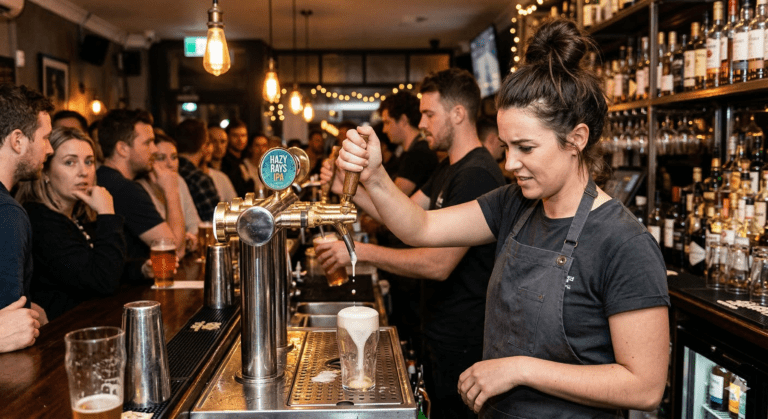
The Liquid Margin: Automating the Taps
A smart back of house operation does not stop at the kitchen door. The bar and cellar represent massive capital investment, yet draught beer remains one of the least monitored and most vulnerable categories in hospitality. Manual weekly stock takes completely miss the daily reality of overpours, unrecorded wastage, and staff sampling.
You cannot hire your way out of shrinkage. Modern operators are turning to automated draught monitoring systems to measure exactly what leaves the keg.
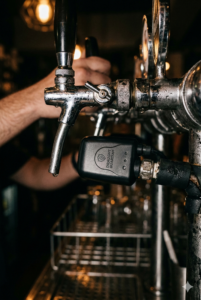
In unmonitored draught environments, operators routinely experience unaccounted pours reaching 15 to 23 percent of their total keg volume. You cannot hire your way out of shrinkage. Modern operators are turning to automated draught monitoring systems, like Draught Guardian, which act as a massive labour force multiplier.
This technology installs real time flow intelligence per tap, per outlet, and per hour. It measures exactly what leaves the keg and cross references it against the POS. If a pint is poured but not rung up, the system flags the exact second the variance occurred.
The Bottom Line
Tech led kitchens survive brutal food inflation by automating their profit protection, while manual kitchens guess their way to closure.
A modern hospitality operation that embraces Smart Kitchens and Thicker Margins integrates kitchen hardware, software analytics, and automated monitoring systems to eliminate waste, optimise inventory, and protect profitability.

Leave a comment