Business
The Babel Effect
A Survival Guide to Labour Inspections
Why labour inspections escalated in South African hospitality in 2025 and 2026
The intensification of labour enforcement across 2025 and early 2026 stems from a nationwide mandate to formalise the hospitality sector. High profile enforcement actions, most notably the Babel Menlyn inspection, served as a catalyst for the Department of Employment and Labour to increase the frequency of unannounced raids. These interventions aim to address systemic compliance gaps in wage practices and employment documentation that surfaced during recent audits in Gauteng, the Western Cape, and KwaZulu Natal.
What inspectors are looking for in restaurants and kitchens
Wages and minimum wage compliance
Inspectors are meticulously auditing payroll records to ensure strict adherence to the national minimum wage and hospitality sectoral determinations. Any deviation from these rates is flagged immediately for enforcement action.
Employment contracts and working hours
Valid, signed employment contracts must be present on site for every staff member. Inspectors verify that recorded working hours and overtime align with the Basic Conditions of Employment Act.
Foreign national documentation and verification
The verification of work permits and visas for foreign nationals is a critical focal point. Employers must maintain a live file containing certified copies of valid documentation and proof of original verification.
Illegal deductions and wage practices
The practice of using tips to subsidise base wages or making unauthorised deductions for uniforms and breakages is being heavily scrutinised. Inspectors look for signed, legally compliant agreements for any deduction made from a staff member’s pay.
Inspection process explained step-by-step
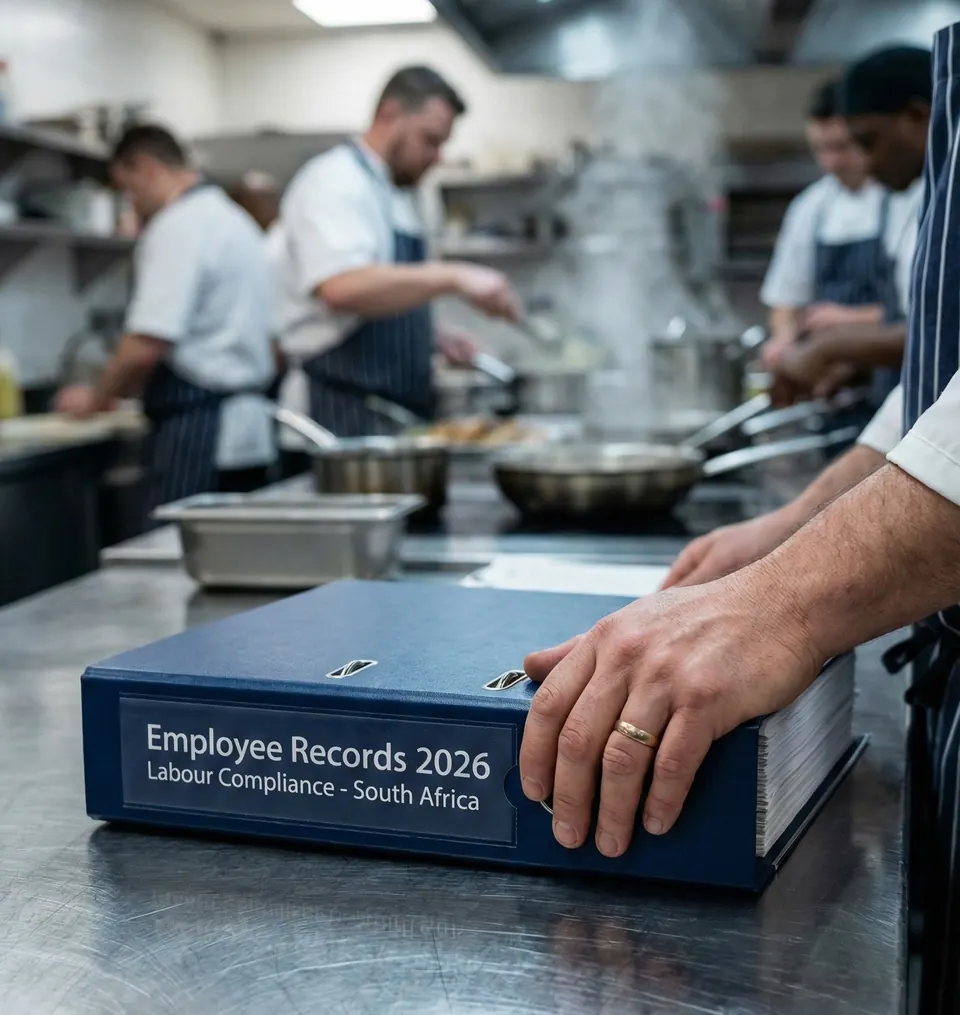
An inspection typically begins with the arrival of officials who present identification and an inspection notice. They have the legal right to enter the premises and interview any employee privately to verify working conditions. Officials will then demand immediate access to the compliance file, including payroll, contracts, and UI-19 forms. The process concludes with the issuance of an inspection report or a compliance order.
Consequences of non-compliance on finances and operations
Non-compliance in 2026 carries severe financial penalties, including orders for the immediate back pay of underpaid wages. Beyond the financial hit, operators face significant reputational damage and the risk of temporary operational shutdowns or criminal exposure for documentation failures.
Preparation checklist for chefs and operators
- Ensure every staff member has a signed, up to date employment contract in their file.
- Maintain certified copies of IDs or valid work permits for all employees, including casual staff.
- Keep the last three months of payroll records and proof of payment easily accessible on site.
- Verify that all UIF and COIDA registrations and payments are current.
- Review all deduction agreements to ensure they are signed and legally defensible.
Operational recommendations
Executive chefs and operators should treat compliance as a daily mise-en-place. Conducting monthly internal audits ensures that the on-site compliance file is always raid ready, moving the business from a state of risk to a state of protection.